
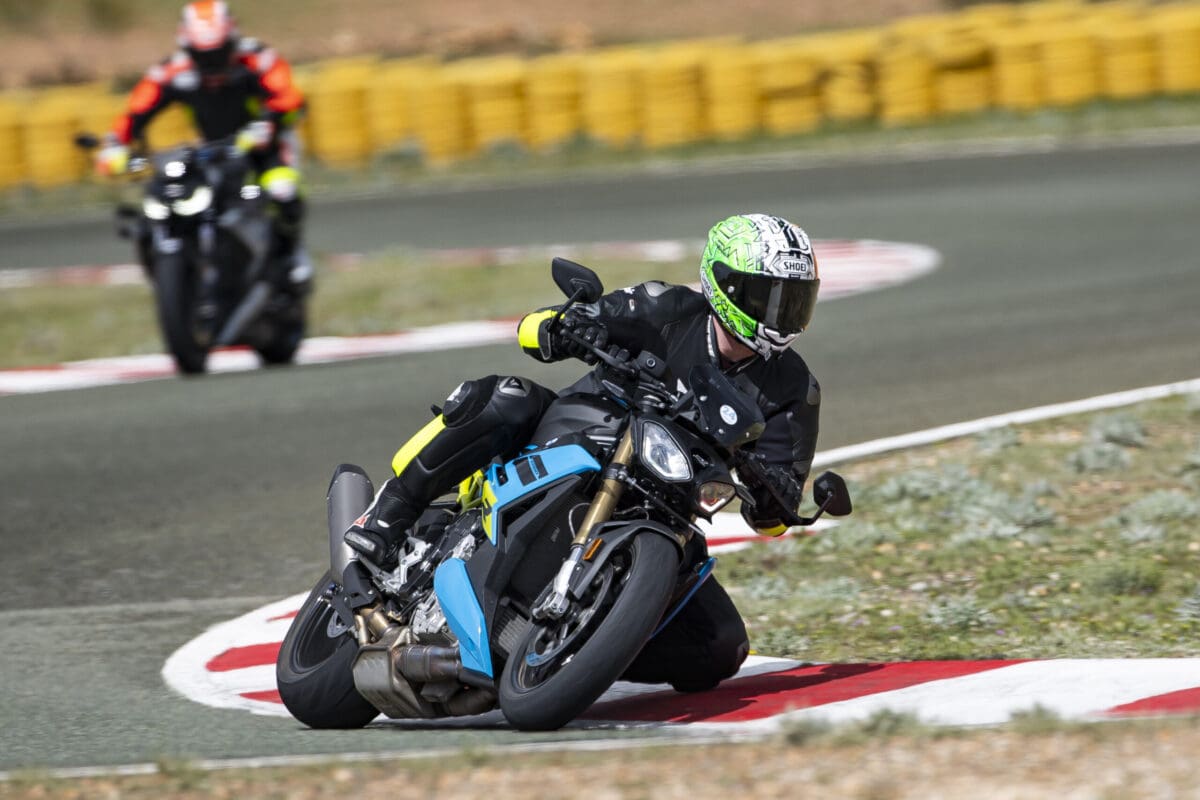
In a bid to keep at the pointy end of supernaked sales, BMW’s kitted its S1000R with a raft of tasty updates, says John McAvoy.
For a manufacturer which has utterly dominated the sales charts and constantly set and reset the bar in terms of performance and tech for sports bikes, the S1000R has never really set the charts alive or captured the hearts and minds of the motorcycling community like the S1000RR has done. It’s a strange thing that a bike which shares so much of its DNA with the “RR” hasn’t taken off in the same way. It must be said that the reason I suspect this is the case, is more to do with the priorities of the people who buy naked bikes – super or otherwise – rather than any performance shortcomings of the S1000R over the years.

I may well be wrong, but I’m of the view that people who buy a naked bike are less worried about outright performance, and place looks and playfulness above lap times, and this is where the S1000R fell short. Whilst being more than adequate and competent as a fun, playful road bike, it just lacked any real “wow” factor either through interaction or visually… to be blunt, it was almost instantly forgettable compared to the likes of the Triumph Speed Triple, KTM Super Duke, Yamaha MT-10, etc.
Enjoy more Fast Bikes Magazine reading every month.
Click here to subscribe & save.
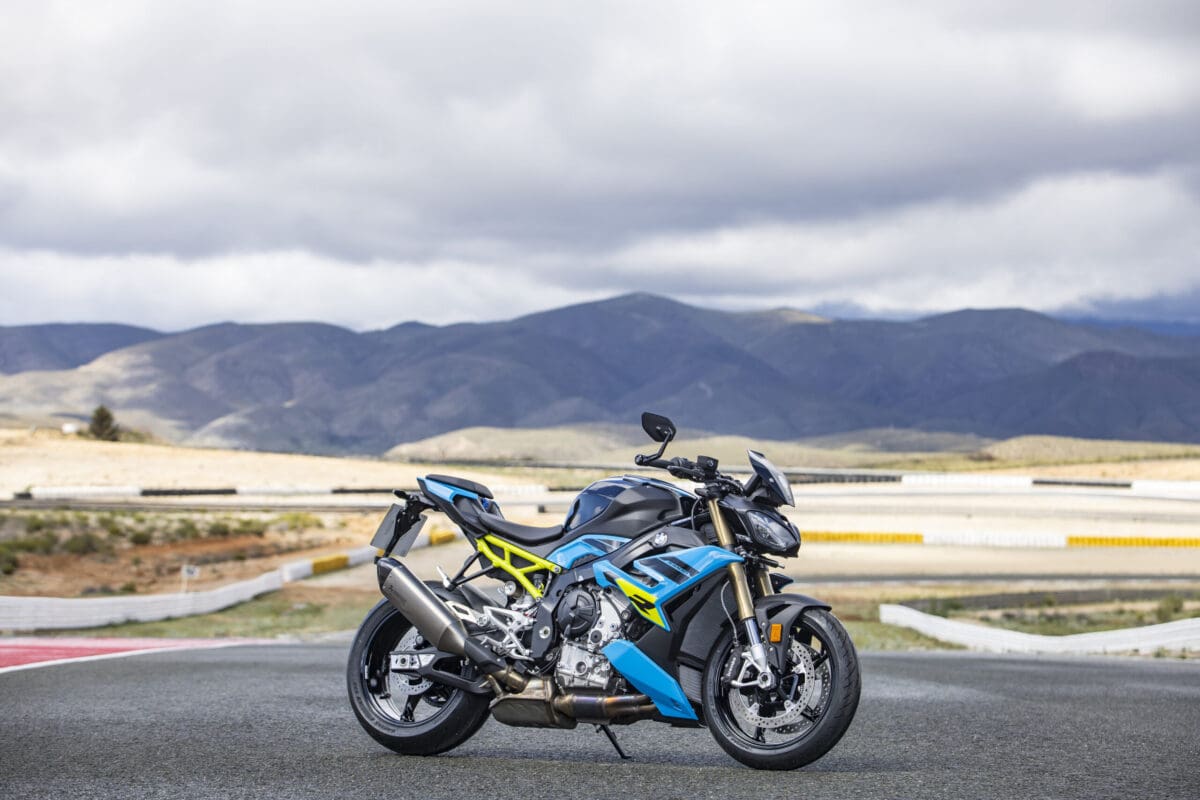
This may well sound like damming praise, and I suppose it is, but when I saw the first pictures of the 2025 S1000R and had a read of the changes made to it, I will admit to feeling somewhat vindicated for my characterisation of the S1000R for being a bit dull. Staring back at me was a light blue and fluorescent yellow S1000R, with some added power, shorter gearing, M1000R electronics, a new electronic function to help with heaving braking and a quick action throttle. It’s as though the S1000R has had a mid-life crisis and given up the slippers and sensible haircut in place for some Nike Jordans and a couple of tattoos.

BMW appear to have clocked that in the naked bike sector at least, style and value often counts for more than substance – just look at what the Hornet 1000 has done to the sector – and rather than re-inventing the wheel, have made a series of very specific and deliberate adjustments to how the engine interacts with the rider rather than any vast increase in horsepower, after all they have the M1000R if you really must have 200BHP. The 2025 S1000R is probably about 95% the same bike in terms of hardware from the 2024 bike, so on the surface you could be forgiven for thinking it is therefore the same and not really worth paying attention to, but because the 5% that is different is so targeted and makes such a big contribution to how a bike feels, that it is abundantly clear that BMW have deliberately decided to reposition the S1000R in order to get more out of the sector.
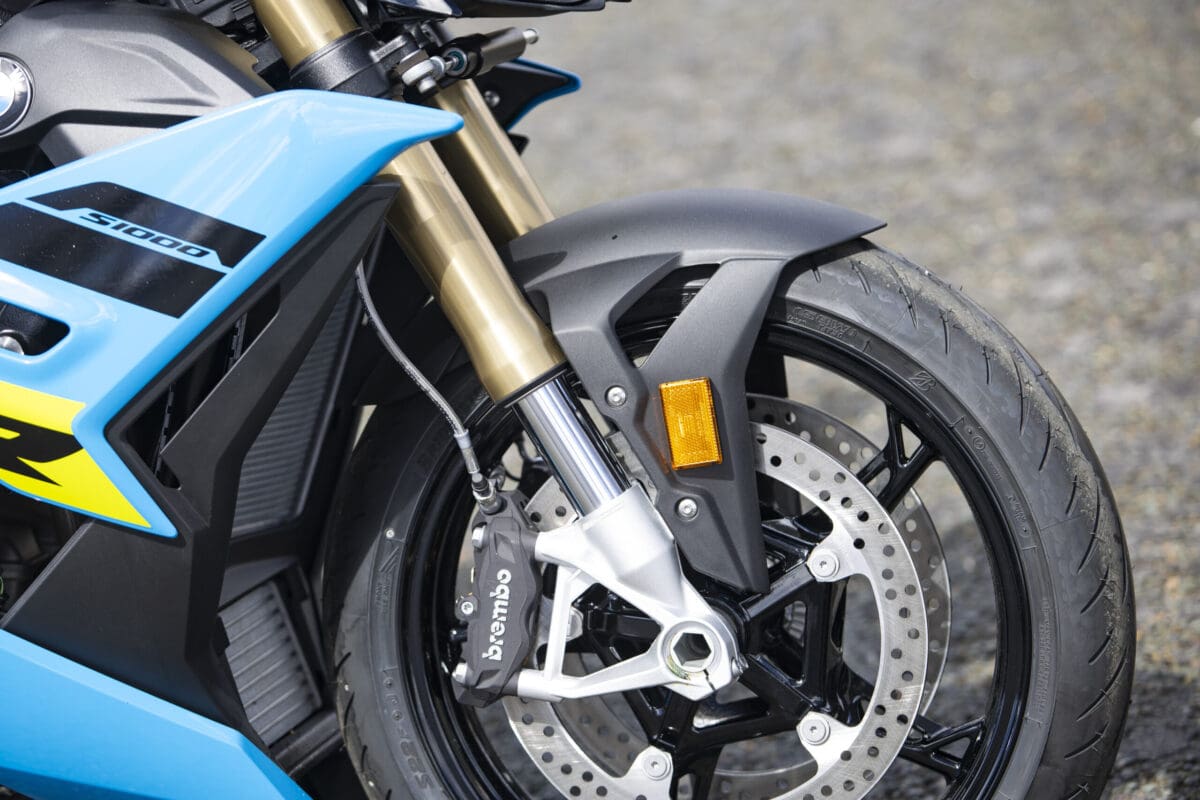
One of the S1000R’s ace cards was always that it offered extraordinary great value for money by offering more bang for less buck compared to its rivals, but that pesky Hornet has come along and by offering less for, err… less, and makes a very strong case, so it’s worth breaking down the S1000R’s value argument. As a reminder, the Hornet SP has Ohlins rear shock, Brembo Stylema brakes, 155BHP, bespoke chassis and pretty basic electronics for £9999. For £13,760, you get an S1000RR chassis, 170BHP from the S1000XR engine which doesn’t have the RR’s shift cam technology and sophisticated electronics from the M1000R, so in terms of hardware and software, the BMW isn’t messing about, it’s right out of the top drawer. However, if you go for an S1000R Sport – which 99% of purchasers do – you can add electronic “DDC” suspension, quickshifter and blipper and an extra rider mode that lets you create an individual mode with all your favourite settings from all the rider aids. You’re now at £15,740, then if you add the teenage paintjob and optional “Comfort Pack” which was on our test bikes, and which adds more spec to the bike including keyless ignition, cruise control, heated grips and tyre pressure sensors to take you to a not insignificant £17,540, which in terms of value still smashes it out of the park because that is a vast amount of spec for the money… but it’s still £17K. The Hornet and S1000R can both make a strong case for value for money, they just go about it differently, and which is more appealing is down to you.
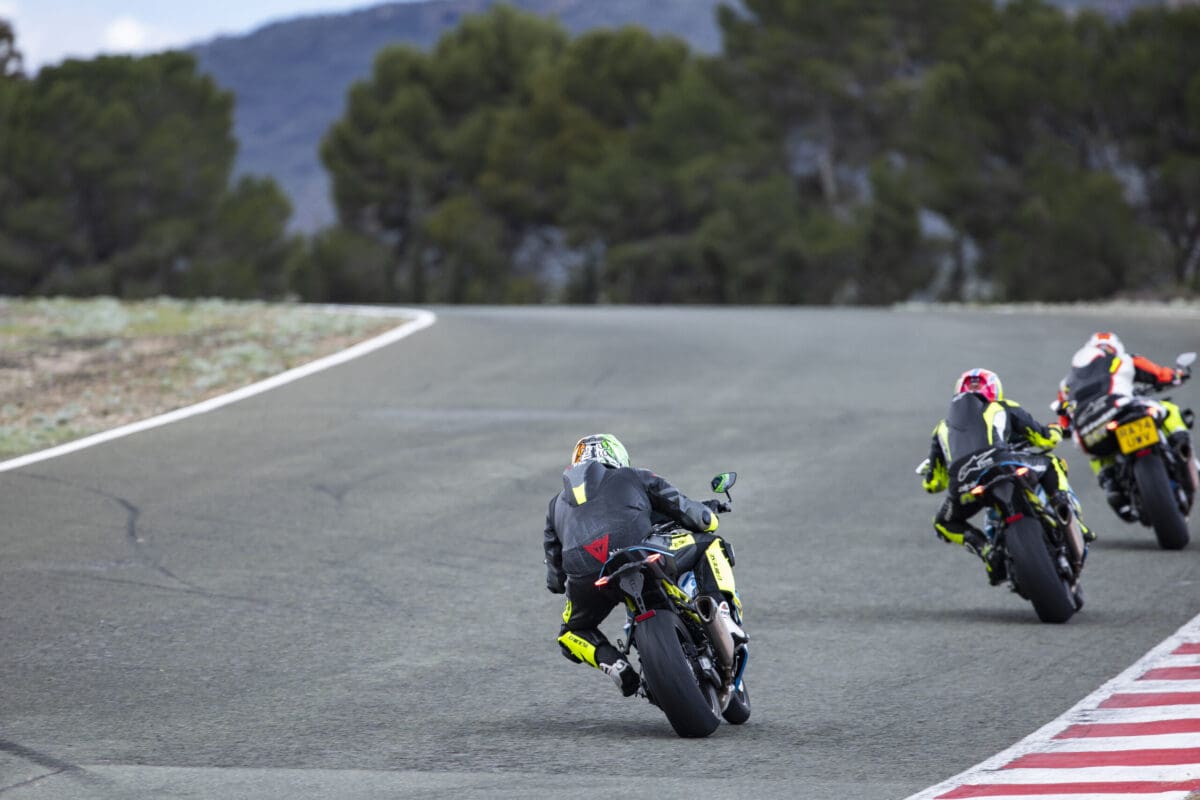
BMW chose to launch the bike on track, which I must admit was a bit of a shame for me, as I already know the S1000R was great on track, and recently I’ve ridden the Hornet and Z900 on the road, not to mention that it was on the road that the S1000R left me wanting more. However, as luck would have it, on the day we rode the bikes it absolutely hosed it down with rain, so teetering around on a soaking wet track while not exactly the same as riding on the road, does ask for a far more delicate riding style more akin to riding on the road, as opposed to a full on beating that a bike gets on a dry track. The throttle grip and brake lever are treated with far more respect in sketchy conditions, but still, the BMW felt much more playful and responsive than before, and I’d even go as far as saying that it was a lot of fun despite being conditions that I wouldn’t walk my dog in. Straight away, the quicker action throttle that now only rotates 58 degrees from fully closed to fully open as opposed to 72 degrees on the old bike, and shorter gearing made the bike feel much more like an extension of me rather than something underneath me that I was just operating. I suspect the fact that the fuel and ignition maps in the ECU have also been reworked for more refinement as well as to be matched with the new quick action throttle – which is why you won’t be able to fit it to your 2024 bike in case you’re wondering.
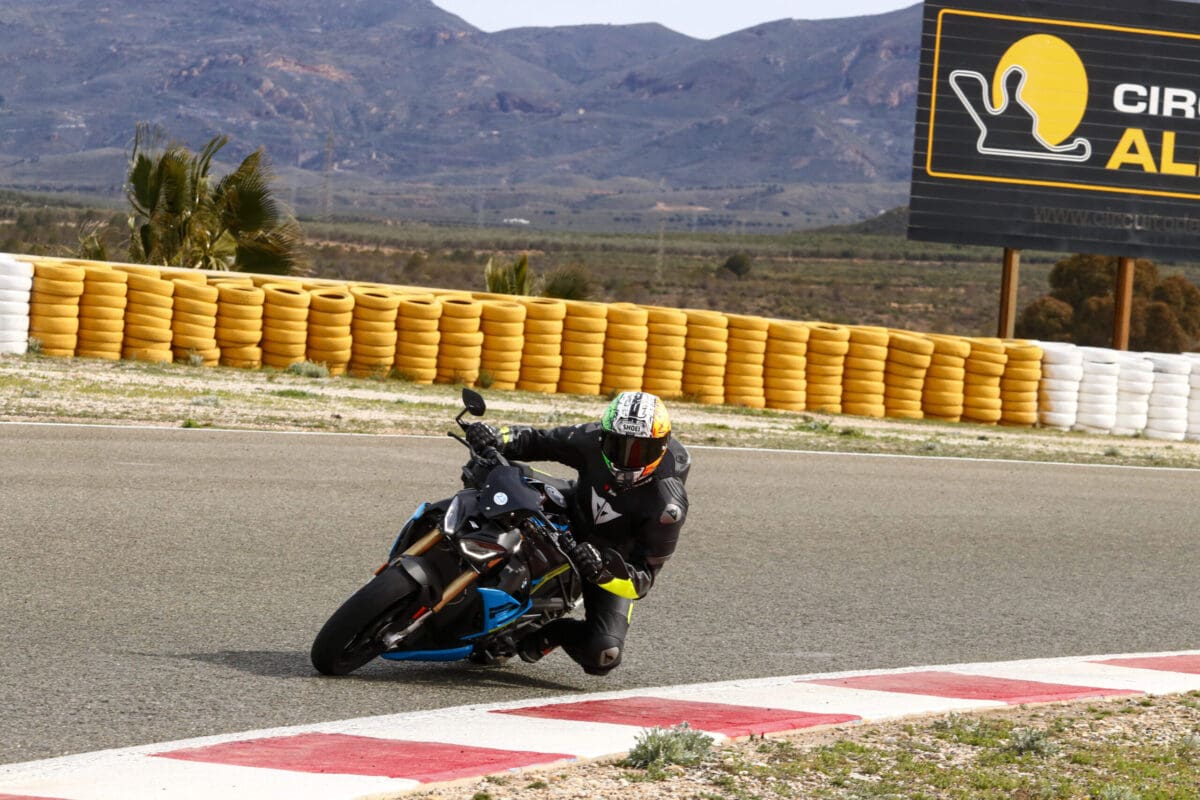
As the day went on, the track and my leathers eventually dried out, but not without a few sneaky damp patches lurking to catch me out. Nonetheless, the lean angle gauge would show either 51 or 52 degrees of lean on both sides at the end of a session, which supports my overriding feeling of having tons of confidence in the bike in dry conditions but also mindful that there were plenty of stealth damp patches waiting to catch me out, which one nearly did. The exit of turn 2 at Almeria circuit is a fully committed 3rd gear blind crest with a camber change and needs a good dollop of power to get the bike out of it and turned ready for the next left hander. The rear Bridgestone S22 let go quite suddenly and not in a nice way, but a combination of clearing the damp patch back onto dry tarmac, and the excellent traction control calming the lurid slide down meant that instead of being sent into orbit with what would have been the mother and father of all highsides, I was able to finish the session – but with a bit less greed on the exit of turn 2. All the electronic systems had worked exactly as they should, and while I’d seen the light flash a few times on the dash, I never actually felt it working, apart from my damp patch moment and later on when the rear tyre was well past its best and beginning the struggle at full lean without even any throttle.
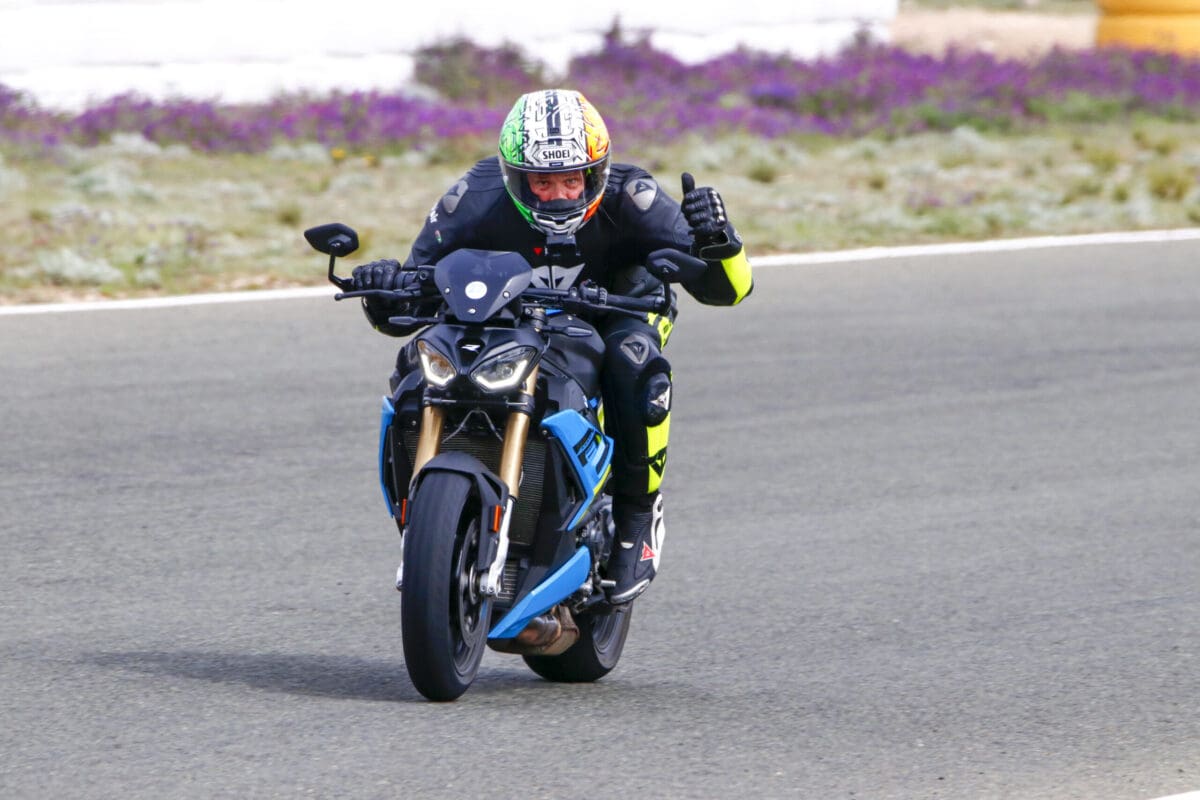
You can tell that the electronics are on a very sophisticated level with not just how it cuts in when something kicks off, but how soon after and how smoothly it releases the power back in. The S1000R’s traction control is right up there with the very, very best that you’d find on bikes twice its price, which shouldn’t be a surprise given that it’s from the M1000R, which is of course from the M1000RR – a bike that is twice the price of the S1000R. The cut and release of the power by the ECU is so smooth, that it feels unfair to refer to it as cut and release. It’s more of a very subtle reduction and reintroduction of power that it’s barely noticeable.

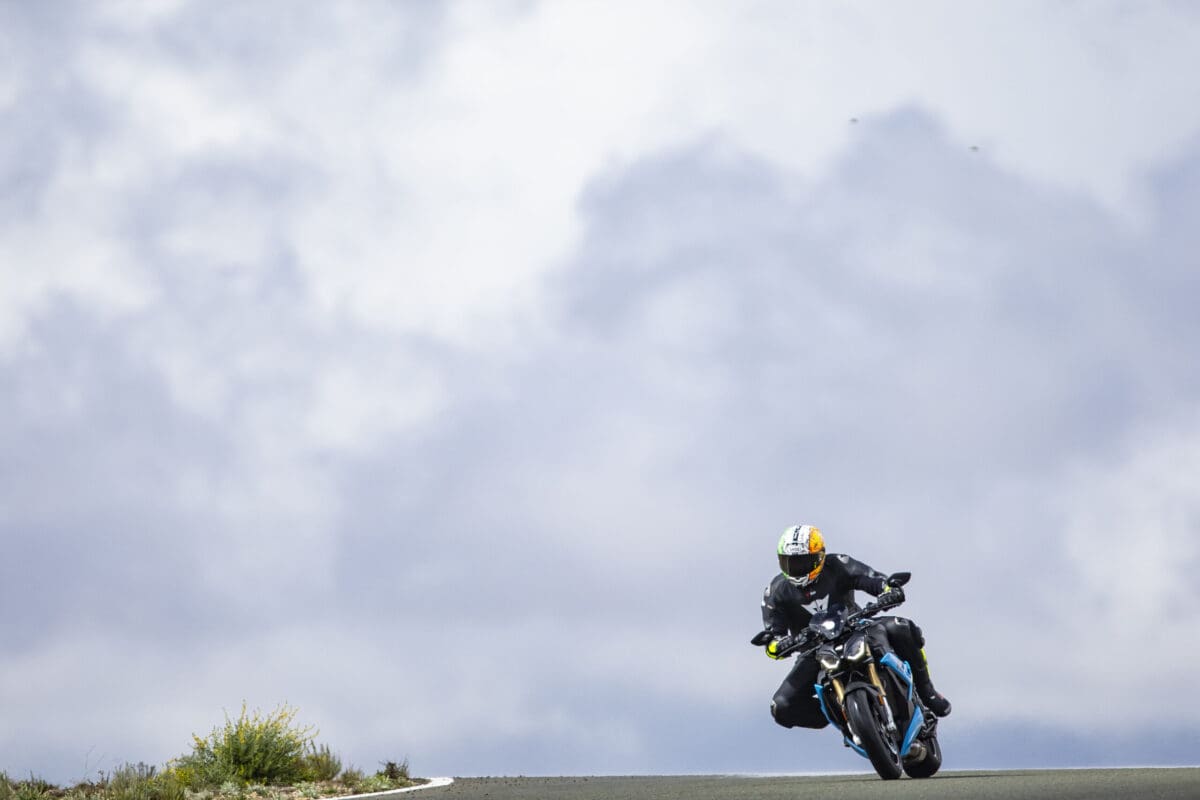
By the end of the day, even in the knowledge that the rear tyre was done, I had enough confidence in the smoothness of the system to not only scoop up any problems, but also to do so in a way that wouldn’t upset the rest of the bike, which given that it’s an S1000RR chassis and suspension is of course right at home on the track. There are a few places on the lap that you can really load up the chassis with high amounts of cornering forces such as the long left handed turn three, and there’s a couple of fairly high speed direction changes and a monster of a braking zone that you come down from nearly flat out in 6th gear to about 30mph in 2nd gear. All of those parts on the lap put a lot of load through the chassis in one direction or another, and the bike remained stable at all times, even in scenarios that can see naked bikes display a degree of instability such as high acceleration zones and high speeds, the S1000R remained stable.
I think the shorter gearing certainly helped the stability out of the slower 2nd gear corners, by simply picking the front wheel up off the floor, thus effectively removing any chance of weaving by only being on one wheel. The previous S1000R didn’t punch out of corners in the same way, and ironically as such was more prone to a bit of weaving under hard acceleration. Even at very high speeds north of 150MPH down the long back straight when usually any naked bike will start to feel uncomfortably light at the front due to the amount of lift generated by the wind pressure.
In the absence of a fairing to hide behind and to cut a neat hole in the air, a naked bike which itself is not in the slightest bit aerodynamic will have its rider acting as a sail catching the full force of the wind blast, and because the position of that sail is well above the bike’s centre of gravity, the front will go light relative to the rear – one of the main ingredients for instability. On a naked bike, there is actually a practical case as opposed to a vanity case for a set of wings to help try and restore weight distribution at speed, but curiously for a company that does love a nice big set of wings, BMW have left them off the S1000R, although in fairness I didn’t find any issues with high speed which is the main thing.
As if to ram the point home that BMW aren’t holding back on the spec of the S1000R, it gets one of their latest innovations lifted straight of the S1000RR and M1000RR, abbreviated to MSR which is an electronic “engine drag torque control” system. I’m not sure how they got to an abbreviation of MSR from that, but nonetheless, the purpose of it is to tidy up any rear wheel locking under heavy braking that the slipper clutch doesn’t catch first. You’re probably looking at scenarios where the rear tyre grip is low due to wear. The point is that it is a very specific set of circumstances that all things being equal should never really happen, but BMW have added the development to the S1000R all the same, and even though as I mentioned earlier, there is a very, very heavy braking zone at Almeria, I can’t say I noticed anything other than the fact the whole bike is fantastically stable under braking, and throwing in the final backshift at or just after the turn in point felt like taking huge liberties that once upon a time would have been a guaranteed corner entry highside.
The engine braking system is a great example of just how sophisticated and refined the electronics are, and how well they work with the mechanical element too i.e. the slipper clutch and ABS system. The approach to turn one is 4th gear over a crest into a 90-degree fiddly corner with a steep uphill exit. It’s a steep downhill approach that at the start of the day in the wet I would space out my backshifts from 4th gear to 2nd gear very deliberately and get it all done while upright and on the brakes. By the end of the day, I was flying over the crest, waiting for the bike to settle from going light, head for the pit exit to give myself a few extra yards of width, then pull really hard on the brake lever and go back to 3rd at the same time. The engine clearly working hard to process all the back-torque that my very early initial backshift suddenly dumped into it. Even with my brain now teetering on the edge of panic because I’d left it so late again to brake for turn one, I could instinctively tell myself not to panic because the bike can deal with it – that a sign of quality and confidence in the bike.
The next thing I would do is start to get the bike turning, but it felt too soon to go for second because the bike felt like is still processing the initial backshift, but I really need to be in second for the corner, not least because of the uphill exit. I started to turn the bike anyway and commit to pulling it down to the apex, and somewhere about halfway between turning in and the apex, I’d click the gear lever one more time impossibly late and instinctively brace myself for the rear to protest and send me wide… but nothing. The BMW swopped the cogs, the electronics and slipper clutch kept everything stable despite my best efforts, and the apex wasn’t missed, meaning the bike was lined up perfectly for being fired up the hill in second gear, lap after lap. It’s seriously impressive, and a reminder of just how capable the BMW is on track at least, but then it always was, and now I can say hand on heart that the updates have made what we proved was already a more than decent package on track, even better.
I always like to look on a manufacturers marketing material for signs of where they are aiming the bike, and how they summarise the new model in a sentence. Often, it’s quite cheesy nonsense that is laughable, but I must confess that while there is a fairly large slice of fromage with the strapline that BMW have given the 2025 S1000R. BMW say “There is no resting pulse” when it comes to the S1000R. I say we’ll see about that because for me, the true test for the S1000R is yet to come… out on the road.

Specs:
BMW S1000R
Engine:
Type: 999cc, liquid-cooled, In line 4-cyl
Bore x stroke: 80mm x 49.7mm
Compression: 12.5:1
Fuelling: EFI
Claimed Power: 170bhp @ 11,000rpm
Claimed Torque: 114Nm @ 9250rpm
Chassis
Frame: Cast Alloy beam frame
F Suspension: 45mm upside down forks, DDC electronic damping and preload control
R suspension: Monoshock, DDC electronic damping and preload control
Front brakes: Nissin monobloc callipers, 32mm twin discs
Rear brake: Single-piston caliper, 220mm disc
Electronics.
Riding Modes: Yes
Traction Control: Yes
ABS: Yes
Quickshifter/Autoblipper: Yes
Wheelie Control: No
Launch Control: No
Dimensions:
Wheelbase: 1447mm
Seat Height: 830mm
Wet Weight: 199Kg
Fuel Capacity: 16.5 litres
Info:
Price: £13760 (£15740 for Sport, £17,540 as tested)
From: www.bmw-motorrad.co.uk